Saturday, May 19, 2012

Sam Hallam :100 more convictions 'potentially unsafe'

Support for Sam Hallam outside Court of Appeal
Further evidence placed Hallam elsewhere the night of the killing

Related Stories

There are about 100 potentially unsafe convictions being investigated, according to a group that campaigns for people wrongly put behind bars.

Innocence Network UK has "serious doubts" over scores of convictions, said its founder Michael Naughton of the University of Bristol.

His comments come as Sam Hallam, 24, spends his first weekend of freedom after seven years in prison.

The Court of Appeal ruled this week that his conviction was "unsafe".

Mr Hallam was jailed in 2005 for a minimum of 12 years over the death of Essayas Kassahun, 21, in Clerkenwell, central London, in 2004.

After his release, he said: "I don't want anyone else ever to suffer what I've been through."
Mr Hallam, who lost a conviction appeal in 2007, also thanked the Criminal Cases Review Commission (CCRC) and Thames Valley Police for the "thorough investigation" they carried out into his case.

Speaking on BBC Radio 4's Today programme, Dr Naughton said that it was a "fantastic time" for Sam Hallam and his family. But he warned that it is not an isolated case.

“Start Quote

The system isn't about innocence and guilty in the way that ordinary people might think it is”
"I'm not saying that there are thousands and thousands of people in prison who shouldn't be there. There are certainly thousands of people in prison who say they shouldn't be there but that's a different matter.

"We have a hundred cases being worked on in our 26 Innocence projects and universities around the country.

"And those universities are serious universities - not just Bristol University but Cambridge, Exeter, Durham. There's a long list of universities working on these cases."

He criticised the CCRC for "factually guilty" people having their convictions overturned on technicalities.

"The system isn't about innocence and guilty in the way that ordinary people might think it is. And Sam Hallam overturned his case because there's non-disclosure in his case, so there's an abuse of process.

"In the cases we are working on, we have serious doubts about the evidence leading to their convictions, because of the research and the work that we've done."

But many of these cases won't be referred because they don't fulfil CCRC criteria about evidence available at the time of the original trial, he said.

"What we are calling for are reforms of the CCRC so that it can be better placed to assist people who apply to it who might be innocent."

Miscarriage of justice

Richard Foster, chairman of the CCRC, said: "The test that we apply, the test of safety, is a statutory test. It's not one that we made up ourselves.

"Safety is a test for all of us. If you or I is being prosecuted in court, then you want the processes to be fair as well as the outcome being the right one."

People can be guilty but still suffer a miscarriage of justice, Mr Foster said, pointing to the example of a woman who pleaded guilty to stealing a passport, money and trying to escape the country.

What on the outside may look like a clear case of guilt was not, he said, because she was trafficked to the UK, held in a house and forced into prostitution. She escaped and committed the crimes trying to flee the country.

"Justice was only done because we referred that case," he said


http://www.bbc.co.uk/news/uk-18128330

Friday, May 18, 2012

Barry George : Cleared Of Jill Dando Murder - Barry George In Court Fighting For Compensation

The 52-year-old, who spent eight years behind bars before being found not guilty by an Old Bailey jury in 2008, will be one of five lead cases to be heard at the High Court this autumn, a judge ruled today.
They will test who is now entitled to payments in "miscarriage of justice" cases following a landmark decision by the Supreme Court in May last year.
The ruling meant that victims of such miscarriages would be able to claim compensation if the new evidence that cleared them would have meant they never could have been convicted in the first place.
It redefined what constitutes a "miscarriage of justice" and expanded it from the current rule that someone must be completely exonerated by a court.
The definition is important because only cleared convicts who are deemed to have suffered a miscarriage of justice are entitled to a pay-out. ...read more


http://www.telegraph.co.uk/news/uknews/crime/9274762/Cleared-Jill-Dando-murder-suspect-Barry-George-in-court-fight-for-compensation.html

Emma Winnall :PC Sanghar PC0318HSANGHAR - A Job Well Done Even If You Did Get An Official Bollocking For Tweeting The Good News . God Bless You Sir.

Police officer reprimanded for tweeting he had arrested 'offenders' over beating of elderly great-grandmother in her bed

  • Great-grandmother Emma Winnall found unconscious and covered in blood
  • West Midlands Police apologise for PC Hanif Sanghar's tweets on the case
A police officer has been reprimanded after tweeting that he had ‘arrested the offenders’ over the attack of a 94-year-old woman in her bed.
Great-grandmother Emma Winnall was found unconscious and covered in blood when carers came to check on her on Tuesday morning last week.

She had a fractured skull, a broken arm and wrist and a partially severed finger. The beating was so severe that the frail widow's palms were bruised from her attempts to protect herself, while blood had splattered on to the walls behind her bed.

Emma Winnall was assaulted as she slept at her home in Moseley, Birmingham, some time between 9pm on April 30 and 9am the next morning.
Battered: Emma Winnall was assaulted as she slept at her home in Moseley, Birmingham, some time between 9pm on April 30 and 9am the next morning.

West Midlands Police said a woman, 56, and a man, 28, were arrested at their home in the Hall Green area of Birmingham just before 6.30am on suspicion of assault. They have been taken to a police station in the West Midlands.

But PC Sanghar, who uses the name PC0318HSANGHAR, then tweeted: ‘Folks. I am happy to now tell you that I was part of the team today who arrested the offenders who assaulted Emma Winnall.’

An hour later he added: ‘Folks the arrest is brilliant but guilty by suspicion (as per law) so we still need help please from all of you.’


West Midlands Police last night apologised and said the tweets by PC Hanif Sanghar were 'wholly inappropriate'.


Chief Inspector Sally Seeley from West Midlands Police, said: ‘The man and woman arrested in connection with the attack on Emma Winnall are suspects. They are innocent until proven guilty in a court of law.

 
'Like most people, the officer who tweeted about his role in the double arrest, was shocked by the violent nature of the attack on Mrs Winnall and was keen to update people with the latest development in the case.

Mrs Blencoe and her brother John Winnall make their public appeal for information

‘It is clear that in doing this, he used terminology which was wholly inappropriate.
‘The officer has been advised and the tweets removed. We apologise for any confusion or distress his comment caused.’


Mrs Winnall’s son John yesterday told how his mother would probably never return to her home.


Mr Winnall, from Birmingham, added: ‘My mum is not very well today but she was better last week.


‘I doubt she will go home now. She will probably go to a care home or something when she leaves hospital.


‘She was saying to me last week that she doesn't want to go home because she doesn't think she would be able to sleep. We are all just thankful she is safe and alive.'

Crimestoppers offered a £5000 cash reward in a move backed by West Midlands Police.

Mrs Winnall, who lives in Moseley, Birmingham, worked at the city’s small arms factory during the Second World War. She relies on a wheelchair to get around, and has lived alone since her husband Frank died in 2006, aged 91. 

She has five children, seven grandchildren and four great-grandchildren, some of whom have been by her side in hospital since the assault. 


Mrs Winnall's flat in Moseley, Birmingham, where she was brutally attacked as she slept

PC Sanghar PC0318HSANGHAR   - A HERO


Read more: http://www.dailymail.co.uk/news/article-2146229/Police-officer-reprimanded-tweeting-arrested-offenders-beating-elderly-great-grandmother-bed.html#ixzz1vDwdv2Q7

Thursday, May 17, 2012

C4 Dispatches Preview : City Of London Police Corruption

CityLondonPoliceCorruption 

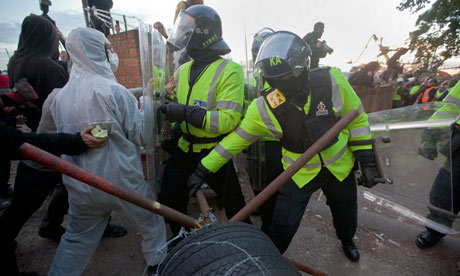
Dale Farm:Police Scattergun Spiked By Media

Dale Farm: why the media had to spike the police's scattergun

It's vital for independent journalism that broadcasters don't have to hand over footage, writes ITN chief executive John Hardie
Dale Farm: vital for the media to draw a line in the sand. Photograph: Sean Smith for the Guardian
 
Today we witnessed a landmark ruling on the distance that must be maintained between the state and the media. A high court judgment quashed a wide-ranging production order that sought to force ITN, the BBC, Sky, Hardcash Productions and freelance photographer Jason Parkinson to hand more than 100 hours of unbroadcast footage of the Dale Farm evictions to Essex police.

 If we had lost this case then the bar would be so seriously lowered for any such future requests that TV cameras could effectively be seen as police surveillance equipment.

The ruling not only found deficiencies in the original decision but underscores the fundamental principle of press independence if we are to report safely and without fear or favour.

We are not agents of the state.

And we felt it was important to fight this case to draw a line in the sand that clearly separates – in the eyes of the law as well as in democratic principle – the roles of the police and newsgatherers.

We had vehemently contested the Dale Farm production order on the grounds that its speculative nature meant that there was no evidence that our footage would be of substantial benefit to the police's investigation and that the request contravened the right to freedom of expression as described in article 10 of the European convention on human rights.

After the disappointment of losing the case at Chelmsford crown court, we took our appeal to the high court by way of judicial review to argue that the orders to hand over footage should not have been made.

This result helps ensure that journalists and cameramen are not seen as an extension of law enforcement and protects the safety of our staff. In the words of Lord Justice Moses and Mr Justice Eady, who handed down today's high court ruling, "it is the neutrality of the press which affords them protection and augments their ability freely to obtain and disseminate visual recording of events".

The court application by police was a fishing trip to identify suspects in unbroadcast footage from the Dale Farm evictions. It was just the latest in a worrying trend to force disclosure of footage. This trend may be linked to the increase in public disorders and demonstrations in recent times. If so, then it is even more important to report such events fearlessly and impartially, lest we risk jeopardising the public's faith in independent journalism.

The Dale Farm order was a nadir because there was simply no evidence that we had any footage of specific value to Essex police. As today's ruling stated: "The speculative nature of this exercise is perhaps underlined by the scattergun approach towards identifying the material sought." Well, now it is time to put the scattergun down.

Yes, we will of course continue to listen to police requests that relate to specific acts of serious criminality – it would be irresponsible for us not to do so.

Media organisations should not consider themselves to be arbiters of the law.

But in our democracy the neutrality and objectivity of independent newsgatherers must be respected. There would have been outrage if we had been ordered to hand over footage of our reporting in Bahrain or Syria to authorities in those countries. We should not be expected to compromise our own position on these shores either.

There is no doubt that today's judgment has set an important precedent for any future police applications to commandeer footage.

What I hope to see come from this ruling is for the police and courts to now take an intense focus on evidence before applying and granting any orders.

 It is one thing for the police to believe that a few seconds of our footage may assist an investigation into a specific incident of serious criminality.

It is completely different for them to deploy their scattergun and hope for the best.

• John Hardie is chief executive of ITN

http://www.guardian.co.uk/media/2012/may/17/dale-farm-media-police?CMP=twt_fd

MET Police To Extract 'Suspects' Mobile Phone Data.

Mobile phone data extraction terminal The kiosks have been fitted in 16 London boroughs for a 12-month trial

Related Stories

The Metropolitan Police has implemented a system to extract mobile phone data from suspects held in custody.
The data includes call history, texts and contacts, and the BBC has learned that it will be retained regardless of whether any charges are brought.
The technology is being used in 16 London boroughs, and could potentially be used by police across the UK.
Campaign group Privacy International described the move as a "possible breach of human rights law".
Until now, officers had to send mobiles off for forensic examination in order to gather and store data, a process which took several weeks.
Under the new system, content will be extracted using purpose built terminals in police stations.
It will allow officers to connect a suspect's mobile and produce a print out of data from the device, as well as saving digital records of the content.
'Retained and handled'

“Start Quote

Mobile phones and other devices are increasingly being used in all levels of criminal activity”
End Quote Stephen Kavanagh Deputy Assistant Commissioner of the Metropolitan Police Service
A Met Police spokesman told the BBC that when a suspect was released, "data received from the handsets is retained and handled in accordance with other data held by the MPS [Metropolitan Police Service]" - regardless of whether charges had been brought.
Guidelines given to officers state that data extraction can happen only if there is sufficient suspicion the mobile phone was used for criminal activity.
"Mobile phones and other devices are increasingly being used in all levels of criminal activity," said Stephen Kavanagh, Deputy Assistant Commissioner of the Metropolitan Police Service.
"When a suspect is arrested and found with a mobile phone that we suspect may have been used in crime, traditionally we submit it to our digital forensic laboratory for analysis.
"Therefore, a solution located within the boroughs that enables trained officers to examine devices and gives immediate access to the data in that handset is welcomed."
'Illegal'
Over 300 London officers will be trained in using the "intuitive, fully-guided touchscreen desktop data acquisition tool", created by mobile forensic firm Radio Tactics.
The cost of leasing the 16 terminals for 12 months and training the officers will be £50,000, the Met said.

Police jackets Privacy International has warned against the possibility of such tech eventually be used on the streets
Privacy International has expressed serious concern over the system.

"We are looking at a possible breach of human rights law," spokeswoman Emma Draper told the BBC.

"It is illegal to indefinitely retain the DNA profiles of individuals after they are acquitted or released without charge, and the communications, photos and location data contained in most people's smartphones is at least as valuable and as personal as DNA."

Ms Draper added that while the Met's current plans were limited to fixed extraction terminals in stations, portable technology was readily available.

"Examining suspects' mobile phones after they are arrested is one thing, but if this technology was to be taken out onto the streets and used in stop-and-searches, that would be a significant and disturbing expansion of police powers."

http://www.bbc.com/news/technology-18102793

#IAPH : Ian Puddick To Address IAPH Annual Conference.

Rob Kelly on Ian Puddick.

Ian Puddick – the guy who last year took on the City of London Police, and won – will be addressing the 27th IAPH Annual Conference in Watford this weekend. Ian has been a friend of mine for a number of years, and has always stood out as a ‘born survivor’ (anyone can jump out of a helicopter, eat snake and sleep in a makeshift tent for three days!) to have the courage to stand up for what he believes in, in the face of huge adversity, Ian definitely has the ‘Thrive Factor’.

http://www.thriveprogramme.org/2012/05/ian-puddick-to-address-iaph-annual-conference/

Follow Rob Kelly On TWITTER

https://twitter.com/#!/thriveprogramme